Leadership in Times of Strategic Retrenchment: Closing the Strategy–Execution Gap in Luxury Retail

Abstract 💡
The luxury retail industry is experiencing strategic retrenchment following post-pandemic expansion, exposing a persistent strategy–execution gap at the boutique level. Corporate initiatives frequently fail not due to flawed design but because frontline employees lack buy-in and alignment with strategic intent. Framed from the perspective of a Vice President of Retail in the USA, this paper examines how multi-level leadership integration can close this gap. Drawing on transformational, adaptive, and servant leadership theories (Northouse, 2024), the analysis proposes a vertically aligned leadership architecture in which transformational executive leadership integrates adaptive regional interpretation and servant store-level engagement. The Retail Leadership Alignment Architecture model positions frontline employee buy-in as the mediating variable between corporate strategy and performance outcomes. Grounded in current luxury industry recalibration, the paper advances leadership coherence as a structural capability necessary for strategy internalization. This conceptual framework lays the groundwork for future empirical research examining organizational, cultural, and leadership factors that influence frontline buy-in in luxury retail organizations.
Introduction
The global luxury retail industry is entering a period of structural recalibration following unprecedented growth during the COVID-19 pandemic. Brands that benefited from elevated discretionary spending now confront slowing demand, margin compression, inventory corrections, and workforce rationalization. Kering’s recent financial disclosures reveal a 13% decline in consolidated revenue and a 33% decline in recurring operating income, with Gucci—its flagship brand—experiencing a 22% contraction (Kering, 2026). Reporting in The Wall Street Journal underscores ongoing demand volatility and strategic restructuring across the sector (Figueras, 2026). These dynamics signal not merely cyclical softness but a reconfiguration of competitive conditions within global luxury retail.
In such environments, strategy formulation is rarely the principal constraint. Rather, the dominant challenge is execution. Organizations frequently develop coherent strategic roadmaps yet fail to realize intended outcomes at the frontline. This phenomenon, commonly described as the strategy–execution gap, reflects a misalignment between strategic intent and behavioral enactment. Porter (1996) emphasizes that competitive advantage emerges from coherent systems of activity; however, coherence requires internal alignment across organizational layers. When leadership behaviors, cultural norms, and operational incentives diverge from strategic positioning, execution deteriorates.
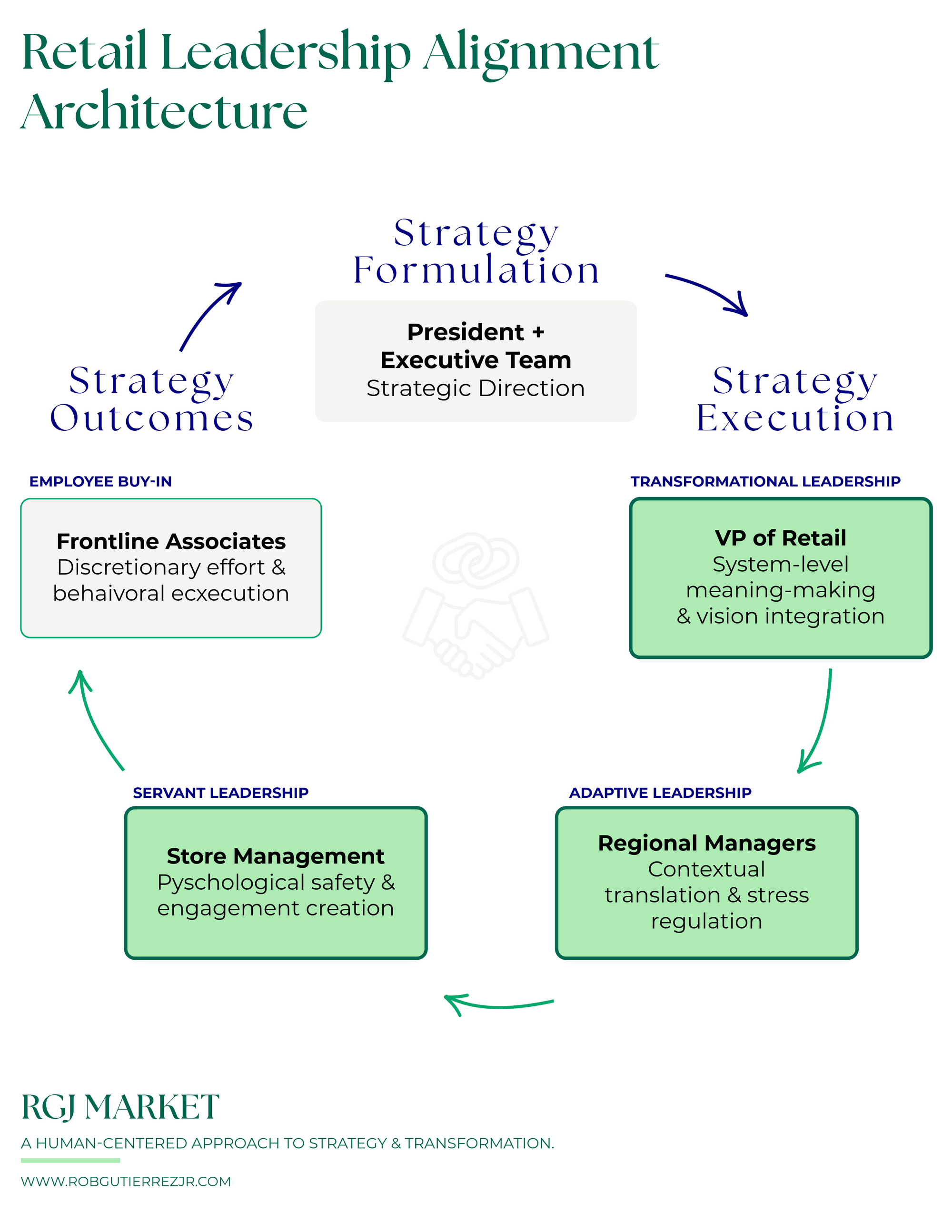
This essay examines the leadership challenge from the situated perspective of a Vice President of Retail in the USA, responsible for translating enterprise strategy into consistent performance across Regions and Stores. The VP role represents a structurally pivotal node in the leadership system—positioned between executive-level strategic direction and frontline behavioral execution. As such, the VP must function not merely as an operational manager but as a transformational integrator who aligns vertical leadership layers under conditions of constraint. The leadership challenge is therefore multi-level: aligning Regional Managers operating in heterogeneous markets and Store Managers responsible for cultivating frontline buy-in.
Drawing upon transformational, adaptive, and servant leadership theories (Northouse, 2024), this paper argues that closing the strategy–execution gap in luxury retail requires vertical leadership coherence. Transformational leadership at the VP level must generate shared meaning and strategic clarity; adaptive leadership at the regional level must contextualize strategy without fragmentation; and servant leadership at the store level must cultivate psychological safety and engagement. Without this multi-level integration, the strategy remains rhetorically compelling yet operationally inert.
Industry Context: Luxury Retail in Strategic Retrenchment
The luxury sector faces what Bain & Company describes as the most far-reaching disruption in over 15 years, marked by slower demand growth, generational shifts in consumption, and fragmented performance across brands (D'Arpizio & Levato, 2025). While Hermès continues to demonstrate resilience, reporting near double-digit revenue growth (Figueras, 2025), Kering and Gucci illustrate the volatility of brand-dependent performance cycles. Kering’s financial report shows revenue in North America declining from €3,949 million to €3,549 million, accompanied by workforce reductions in the region (Kering, 2026). Recurring operating margin fell from 14.5% to 11.1%, intensifying pressure on cost discipline and store productivity. Public statements emphasize a strategic “return to growth” and transformation roadmap (Kering, 2026). However, aspirational messaging does not guarantee alignment at the boutique level.
Porter (1996) distinguishes between operational effectiveness and strategy, noting that competitive advantage arises from coherent positioning, not incremental efficiencies. In luxury retail, execution failure often results from incoherence between headquarters initiatives and store-level realities. Hambrick and Fredrickson (2001) argue that strategy must align arenas, vehicles, differentiators, staging, and economic logic. When these elements are unclear at the frontline, implementation falters.
Sull (1999) warns of “active inertia,” where firms respond to disruption by intensifying outdated behaviors rather than adapting structurally. In retail environments experiencing contraction, performance pressure may trigger command-and-control behaviors that undermine engagement rather than foster innovation. Thus, the leadership challenge is not simply cost containment; it is orchestrating alignment in the face of scarcity.
Theoretical Framework
Transformational Leadership
Northouse (2024) defines transformational leadership as a process that inspires followers to transcend self-interest for collective goals through idealized influence, inspirational motivation, intellectual stimulation, and individualized consideration. In contractionary environments, transformational leadership is particularly critical because it reframes adversity as opportunity and fosters psychological commitment rather than compliance. As VP of Retail, transformational leadership requires articulating a compelling narrative that links corporate recalibration to boutique-level client experience excellence. Rather than communicating austerity, the leader must communicate purpose. Transformational leadership thus becomes the integrative force across hierarchical layers.
Adaptive Leadership
Regional Managers operate within heterogeneous markets shaped by local consumer dynamics, staffing conditions, and competitive pressures. Adaptive leadership involves mobilizing individuals to confront complex challenges, regulate distress, and experiment within constraints (Northouse, 2024). Regions cannot merely transmit headquarters mandates. They must contextualize them. Ghemawat (2007) highlights the importance of managing differences across geographic contexts. Adaptive leaders interpret strategy in light of local variation while maintaining alignment with enterprise objectives. Without adaptive translation, corporate strategy remains abstract.
Servant Leadership
Store Managers represent the critical interface between strategy and frontline behavior. Servant leadership prioritizes follower development, empowerment, and ethical responsibility (Northouse, 2024). In luxury retail, client experience quality is inseparable from associate engagement. Goleman (2017) emphasizes emotional intelligence as foundational to effective leadership. Store Managers must manage emotional labor, morale, and performance simultaneously. Research on frontline retail employees suggests that disengagement often stems from misalignment between expectations and perceived support (Lawson, 2021; Hadjisolomou, 2019). Servant leadership at the store level cultivates psychological safety and discretionary effort, converting strategic directives into authentic client interactions.
If this thinking is useful, consider subscribing to get full access and follow future pieces.
The VP of Retail as Strategic Integrator
The VP of Retail occupies a structurally pivotal role. Upward, the VP must influence the President and executive team, shaping resource allocation and strategic framing. Downward, the VP must inspire Regions and Stores. Hambrick and Fredrickson’s (2001) strategy diamond reinforces the importance of coherence. The VP ensures that arenas (markets), vehicles (activations), differentiators (brand equity), and economic logic (margin discipline) are consistently understood at operational levels.
Knowledge strategy further reinforces this alignment. Hansen, Nohria, and Tierney (1999) distinguish between codification and personalization strategies. Luxury retail execution relies heavily on personalization—the transmission of tacit brand meaning through human interaction. Therefore, leadership must prioritize relational transmission over procedural documentation. Transformational leadership at the VP level serves as the vertical integrator that binds strategy to human systems.
Leadership Under Constraint
Constraints intensify leadership complexity. Limited activation budgets, zero incremental incentive funding, high-frequency performance monitoring, and corporate politics create structural stress. In such environments, financial incentives cannot substitute for intrinsic motivation. Christensen (2025) argues that purpose and meaning ultimately shape sustained commitment. McKinsey research reinforces that talent engagement strongly predicts performance outcomes, particularly during volatility (Hancock & Schaninger, 2020). Thus, the VP must cultivate intrinsic alignment by reinforcing mission, investing in development, and modeling integrity. Servant leadership at store level mitigates burnout; adaptive leadership at regional level absorbs contextual stress; transformational leadership at VP level sustains morale and vision.
Implications for Closing the Strategy–Execution Gap
The findings of this analysis suggest that the strategy–execution gap in luxury retail is not merely a communication failure but a structural misalignment in leadership. The strategy execution literature often emphasizes clarity in goals, incentives, and monitoring mechanisms. However, these mechanisms are insufficient when frontline actors do not internalize strategic intent. This paper advances the argument that leadership alignment operates as a mediating mechanism between corporate strategy and frontline behavioral outcomes. From a transformational leadership perspective (Northouse, 2024), idealized influence and inspirational motivation create shared meaning structures that elevate collective purpose beyond transactional performance metrics. In periods of contraction, where incentive structures may be constrained, meaning-making becomes a primary motivational driver. Thus, transformational leadership at the VP level serves as a strategic integrator, aligning cognitive understanding with affective commitment.
At the meso-level, adaptive leadership theory introduces an essential moderating dimension. Regional Managers confront heterogeneous market conditions, regulatory differences, and localized consumer sentiment. Adaptive leadership enables these managers to recalibrate strategic interpretation without diluting strategic intent. In effect, adaptive leadership moderates the relationship between corporate directives and contextual feasibility. At the micro-level, servant leadership provides the proximal mechanism through which strategy is enacted behaviorally. Servant leaders cultivate psychological safety, empowerment, and relational trust (Northouse, 2024). These conditions are empirically associated with increased discretionary effort and engagement—two constructs central to frontline buy-in. Research on retail frontline disengagement underscores that misalignment between corporate expectations and perceived managerial support contributes to resistance and emotional withdrawal (Lawson, 2021; Hadjisolomou, 2019). Servant leadership mitigates this risk by centering follower development and emotional containment.
The integration of these leadership styles across vertical levels produces what may be conceptualized as leadership coherence—a condition in which strategic meaning is consistently interpreted, emotionally reinforced, and behaviorally enacted across organizational strata. Without such coherence, strategy diffusion becomes fragmented, generating what Porter (1996) describes as operational confusion rather than competitive positioning. Importantly, this framework also reframes performance monitoring systems. In luxury retail, daily and weekly metrics often dominate managerial attention. However, excessive focus on short-term KPIs without parallel investment in leadership alignment can intensify Sull’s (1999) active inertia, where organizations respond to turbulence by amplifying outdated control mechanisms. Leadership coherence, by contrast, transforms monitoring systems into reinforcement mechanisms rather than stress multipliers.
From a dissertation perspective, this essay contributes a conceptual foundation for examining frontline employee buy-in as an outcome variable influenced by multi-level leadership architecture.
The model illustrates how transformational leadership at the VP level functions as a system-level integrator, adaptive leadership at the regional level serves as a contextual translator, and servant leadership at the store level operates as the proximal driver of psychological safety and engagement. Frontline employee buy-in emerges as the primary mediating outcome variable, linking leadership coherence to client experience quality and financial performance. The model conceptualizes leadership alignment as a structural capability rather than an isolated behavioral attribute.
Conclusion
The luxury retail industry’s current recalibration, exemplified by Kering’s revenue contraction and strategic restructuring, illustrates that volatility does not inherently erode competitive advantage. Rather, erosion occurs when leadership systems fail to maintain alignment between strategic ambition and frontline reality. In contractionary environments, organizations face a paradox: resource scarcity intensifies the need for disciplined execution, yet pressure-driven behaviors often undermine the relational foundations required for sustainable performance. Transformational leadership at the VP level provides the macro-integrative function—reframing scarcity as strategic focus rather than threat. Adaptive leadership at the regional level absorbs contextual variability without fragmenting strategic coherence. Servant leadership at the store level ensures that human capital remains emotionally and behaviorally committed despite heightened performance scrutiny. This vertically integrated leadership architecture reframes the strategy–execution gap as a failure of systemic leadership alignment rather than flawed strategy design.
Thanks for reading. RGJ MKT is a reader-supported publication. To receive new posts and support my work, consider becoming a subscriber.
It extends Porter’s (1996) argument regarding strategic positioning by suggesting that competitive differentiation in luxury retail increasingly depends on relational and cultural capabilities—not merely product or branding superiority. Furthermore, this framework aligns with Hambrick and Fredrickson’s (2001) emphasis on strategic coherence. When arenas, vehicles, and economic logic are internally misinterpreted across organizational layers, execution deteriorates. Leadership coherence thus becomes a strategic capability—an intangible asset that shapes how effectively strategy is realized. The implications extend beyond luxury retail. In industries characterized by emotional labor, brand symbolism, and human-mediated value creation, leadership alignment determines whether strategy remains rhetorical or becomes embodied in frontline behavior.
As VP of Retail, USA, the mandate is not only to deliver quarterly results but to architect a leadership system capable of sustaining strategic internalization under constraint. Transformational leadership must operate not as personal charisma but as systemic design. By aligning adaptive and servant leadership across vertical levels, the organization transitions from fragmented compliance to cohesive execution. Closing the strategy–execution gap, therefore, is less a matter of operational refinement and more a matter of leadership architecture. In periods of volatility, competitive advantage resides in the disciplined integration of strategy, culture, and human systems.
References
D'Arpizio, C., & Levato, F. (2025, November 19). Luxury is ready for a new era after stabilizing in 2025. Bain. Retrieved February 1, 2026, from https://www.bain.com/insights/luxury-is-ready-for-a-new-era-after-stabilizing-in-2025-snap-chart/
Figueras, A. (2025, July 29). Gucci owner kering posts sales drop amid lingering weak demand. Wall Street Journal. Retrieved February 1, 2026, from https://www.wsj.com/business/retail/gucci-owner-kering-posts-sales-drop-amid-lingering-weak-demand-ac931b87?gaa_at=eafs%26gaa_n%3DAWEtsqevwTuygm2wYQkEfnfY5wQM4zVEXHBaygMU5HVnaa8tg99I4zF82TB6&gaa_ts=69926905&gaa_sig=6gszlIkGi7DxuBhVFnI9aSwItUFTEOT_49kGideVDKNFckUg6CHm8AYd5uiVpcxBboP_VsoAE6UazqKDnfVhHw%3D%3D
Figueras, A. (2026, February 10). Kering shares surge on hopes for a sustained rebound for Gucci. The Wall Street Journal. Retrieved February 10, 2026, from https://www.wsj.com/business/retail/gucci-owner-kerings-sales-accelerate-as-push-to-get-core-brand-back-in-fashion-continues-98eb5d29?gaa_at=eafs&gaa_n=AWEtsqdduK6l1YfZnn6QSks0969RyjRJxJFXCWORvZcR2wlsTudKH1EGi4W0&gaa_ts=69925bc7&gaa_sig=PDSBj0yr_2r-QGns6u8EAYVGZVce_-EwWt7vUhEFRaSronTsQzxREVm0sgNYREGA75SaZrLdSmY7WnQQaPlreA%3D%3D
Ghemawat, P. (2007). Managing differences: The central challenge of global strategy. Harvard Business Review, 85 3(3), 58–68, 140. Retrieved February 1, 2026, from https://doi.org/10.1108/sd.2007.05623had.001
Goleman, D. (2017). What makes a leader? (Harvard business review classics) (1st ed.). Harvard Business Review Press.
Hadjisolomou, A. (2019). Front-line service managers' misbehaviour and disengagement: The elephant in the store? Employee Relations, 1–35. https://doi.org/10.1108/ER-06-2018-0176
Hambrick, D. C., & Fredrickson, J. W. (2001). Are you sure you have a strategy? Academy of Management Perspectives, 15(4), 48–59. https://doi.org/10.5465/ame.2001.5897655
Hancock, B., & Schaninger, B. (2020, July 27). HR says talent is crucial for performance—and the pandemic proves it. McKinsey & Company. Retrieved January 30, 2026, from https://www.mckinsey.com/capabilities/people-and-organizational-performance/our-insights/hr-says-talent-is-crucial-for-performance-and-the-pandemic-proves-it
Hansen, M. T., Nohria, N., & Tierney, T. (1999). What's your strategy for managing knowledge? Harvard Business Review, 106–116.
Kering. (2026). 2025 Full-Year Results [2025 Financial Results]. https://www.kering.com/en/finance/publications/
Lawson, A. (2021). Frontline retail employees – extinct or evolving: A look at the relationship between, servant leadership, employee engagement, organizational change recipients' belief and employee intent to quit [Doctoral dissertation, Graduate College of the Oklahoma State University]. ProQuest Dissertations and Theses Global. https://www.proquest.com/openview/7d64ba4afbca5b6e601cf38cfa294621
Northouse, P. G. (2024). Leadership: Theory and practice (10th ed.). SAGE Publications.
Porter, M. E. (1996). What is strategy? Harvard Business Review.
Review, H. B., Drucker, P. F., Gallo, A., Su, A. J., & Christensen, C. M. (2025). Hbr's 10 must reads on managing yourself, updated and expanded (featuring "how Will You measure... Your life?" by Clayton M. Christensen)(Updated,Expanded ed.). Harvard Bus Review Press.
Sull, D. L. (1999). Why good companies go bad. Harvard Business Review, 77 4, 42–8, 50-2, 183.
Your Perspective 🎙️
If this analysis resonates or challenges your perspective, I invite you to contribute to the discussion below.
Where are you seeing the strategy–execution gap appear in your organization?
Thoughtful dialogue sharpens the work.