The Retail Leadership Alignment Architecture Framework
When leadership layers misalign, the brand promise erodes—not because of product weakness, but because of relational inconsistency.

Why It Exists and Why It Matters Now 💡
In my recent essay, Leadership in Times of Strategic Retrenchment: Closing the Strategy–Execution Gap in Luxury Retail, I argue that the strategy–execution gap in luxury retail is not primarily a failure of strategy design—it is a failure of leadership alignment. Luxury brands rarely lack strategic ambition. They lack vertical coherence—the disciplined integration of leadership behaviors across organizational layers.
The RLAA (Retail Leadership Alignment Architecture) framework, see Figure 1., emerged from a recurring observation within multi-unit luxury retail organizations: strategy is typically communicated with clarity at the executive level, yet its operational meaning becomes progressively diluted as it travels downward through the organization.
At headquarters, strategy is discussed in terms of positioning, growth priorities, client development initiatives, and brand equity. Executives speak in the language of markets, investment horizons, and competitive differentiation. These conversations operate at a high level of abstraction. Their purpose is to define the organization’s direction.
However, the actual realization of strategy occurs at the frontline. It takes shape through thousands of daily interactions between associates and clients. It manifests in how store managers coach their teams, how regional leaders allocate attention, and how performance expectations are interpreted in local markets. The distance between these two worlds—the strategic and the operational—is where the strategy–execution gap emerges.
In theory, communication should resolve this gap. Organizations invest heavily in cascading messaging: town halls, leadership summits, performance dashboards, and operational guidelines. Yet communication alone rarely produces alignment. The issue is not merely whether leaders hear the strategy but whether they interpret it consistently and enact it behaviorally.
During expansionary periods, this fragmentation can remain invisible. Strong traffic and high demand allow stores to deliver results even when leadership alignment is incomplete. Teams compensate through effort rather than structure. The organization continues to grow despite internal inconsistency. Retrenchment changes the equation.
When demand slows and resources tighten, organizations must rely more on disciplined execution than on favorable market conditions. Leaders face difficult trade-offs: reduced activation budgets, stricter cost control, limited incentive flexibility, and higher scrutiny of productivity. Under these conditions, the relational dynamics of leadership become decisive.
If regional leaders interpret strategy differently from headquarters, stores receive mixed signals. If store managers experience pressure without psychological support, frontline engagement deteriorates. If leadership communication emphasizes performance metrics without reinforcing purpose, employees begin to view strategy as surveillance rather than direction.
The RLAA exists to address this structural vulnerability. The framework proposes that closing the strategy–execution gap requires vertical leadership coherence—a condition in which strategic meaning is consistently interpreted, emotionally reinforced, and behaviorally enacted across organizational layers.
This is not motivational rhetoric. It is leadership architecture.
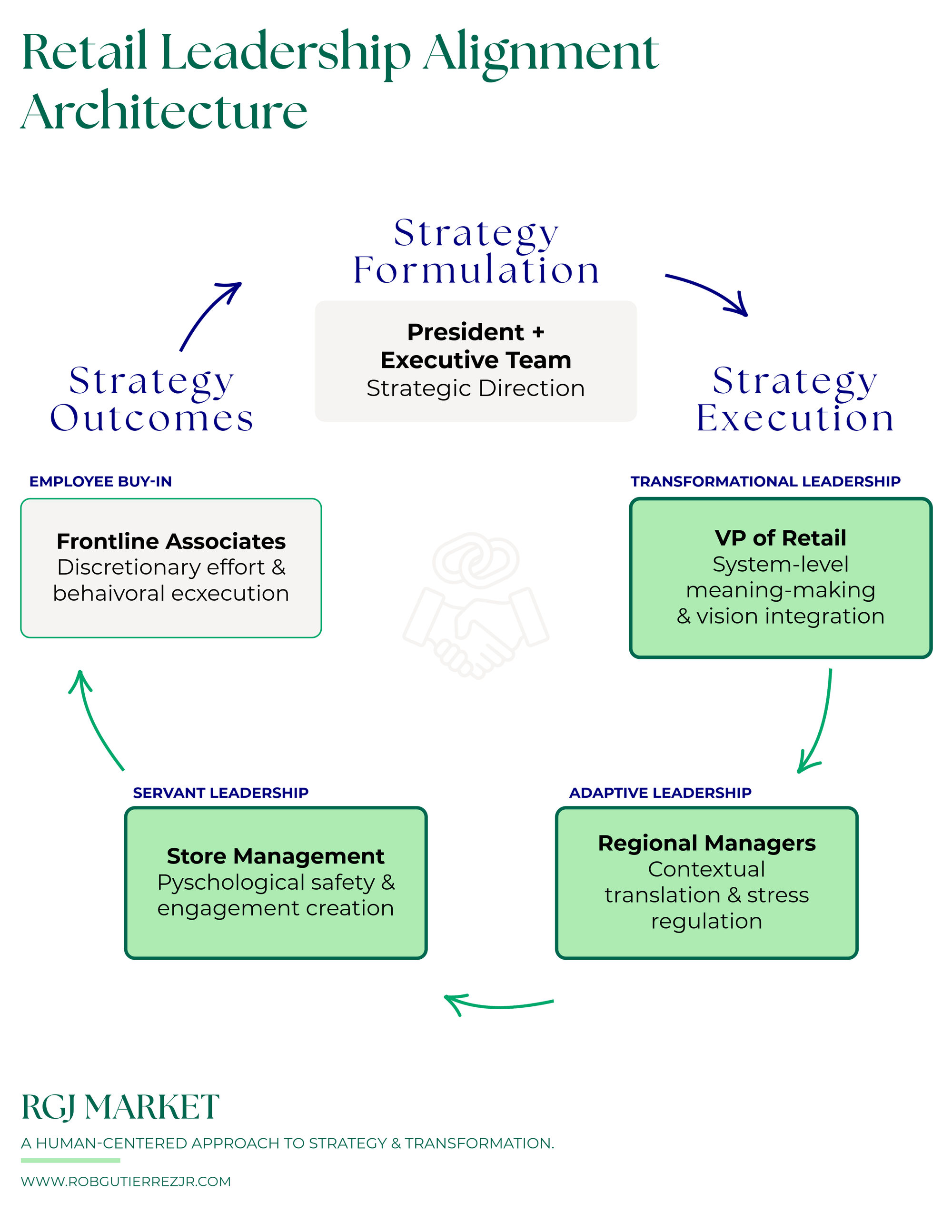
In this architecture, leadership is not treated as a single behavioral style. Instead, different leadership functions operate at different levels of the organization. Transformational leadership provides integrative meaning at the executive level. Adaptive leadership allows regional leaders to translate strategy into local realities without distorting its intent. Servant leadership ensures that store managers cultivate the psychological conditions necessary for frontline engagement.
Together, these leadership dynamics create a coherent system through which strategy can travel intact from the executive level to the boutique floor. The RLAA framework, therefore, reframes the strategy–execution gap not as a failure of communication, nor as a deficiency of frontline discipline. It is fundamentally a problem of leadership architecture.
Organizations do not execute strategy through documents or dashboards. They execute strategy through people, and people require alignment.
Practical Implementation: What RLAA Looks Like in Action
Frameworks fail when they remain conceptual. RLAA must be operationalized through disciplined leadership routines, structural reinforcement, and behavioral metrics. Below is what implementation looks like in practice.
1. VP-Level: Transformational Integration
Objective: Create strategic meaning and interpretive consistency.
Practical actions:
- Quarterly Strategic Narrative Briefings
Not just financial reviews, but structured storytelling sessions linking corporate recalibration to boutique-level client experience expectations. - Strategic Translation Documents
A one-page “Executive to Region” strategy brief answering:- What is changing?
- What is not changing?
- What behaviors must shift?
- What metrics will matter most?
- Leadership Calibration Forums
Monthly calls with Regional leaders explicitly focused on interpretive alignment, not just performance reporting. - Behavioral Modeling
Consistency between what is emphasized in communication and what is rewarded in evaluation.
At this level, the VP acts as integrator—reducing ambiguity before it cascades downward.
2. Regional Level: Adaptive Translation
Objective: Contextualize strategy without distorting intent.
Regions operate in heterogeneous markets—different traffic patterns, client demographics, staffing realities. Adaptive implementation includes:
- Market-Specific Action Plans
Each Region submits a 60–90 day localized execution roadmap aligned to enterprise objectives. - Distress Regulation Protocols
Structured conversations with Store Managers during downturn cycles:- What constraints are you facing?
- What trade-offs are emerging?
- Where is morale under pressure?
- Experimentation Windows
Allow limited, controlled flexibility in activation tactics while maintaining non-negotiable brand standards. - Feedback Loops to VP Level
Formal upward reporting on strategic friction points, not just results.
Adaptive leadership absorbs complexity without fragmenting coherence.
3. Store Level: Servant Execution
Objective: Convert strategy into human behavior.
Store Management operationalize RLAA through:
- Psychological Safety Routines
- Weekly team debriefs.
- Open forums for frontline tension.
- Transparent performance discussions without punitive tone.
- Behavioral Alignment Coaching
Not just “sell more,” but:- How does this strategy show up in clienteling?
- How does it shape appointment culture?
- How does it alter follow-up expectations?
- Engagement Tracking
Monitor:- Voluntary turnover.
- Associate participation in development.
- Client repeat rates.
- Observed service consistency.
Servant leadership does not mean softness. It means disciplined investment in human capability under constraint.
If this thinking is useful, consider subscribing to get full access and follow future pieces.
Reinforcement Systems
RLAA requires structural reinforcement:
- Performance reviews that measure leadership behavior, not just revenue.
- KPI dashboards that include engagement indicators.
- Incentive systems aligned with strategic priorities.
- Leadership training explicitly tied to the three-level architecture.
Without system reinforcement, the framework collapses into theory.
A Definitive Model—and an Evolving One
RLAA framework is definitive in its structure: leadership coherence closes the strategy–execution gap. It is also evolving.
As my doctoral research continues, I am refining:
- Measurement constructs for frontline buy-in.
- Moderating effects of regional heterogeneity.
- Quantitative linkage between leadership coherence and financial outcomes.
- Governance mechanisms sustaining alignment over time.
The objective is not academic abstraction. It is operational rigor.
Beyond Retrenchment
While developed in retrenchment conditions, RLAA applies equally to:
- High-growth scaling.
- Brand repositioning.
- M&A integration.
- International expansion.
Next Steps
If you want the full academic foundation behind RLAA, read:
 Robert Gutierrez Jr.
If you are a founder, executive, or retail leader navigating scaling, retrenchment, or structural recalibration:
- Subscribe to RGJ MARKET for ongoing research-driven insights on leadership architecture in luxury retail, click here.
- Or schedule a Strategy Workshop to apply the RLAA model directly to your organization’s leadership system, click here to learn more.
Strategy does not fail in PowerPoint. It fails in translation. RLAA is designed to close that gap.
Join the Conversation Below 🎙️
Where does vertical misalignment surface most in your organization?
- Executive messaging?
- Regional interpretation?
- Store-level engagement?
- Incentive systems?
Where does strategy begin to fragment? I welcome your insights.